Introduction: Singapore’s Marketing Wake-Up Call
Singapore is a results-driven market. Ideas are cheap. Execution is expensive. And patience is rare. As customer attention fragments and digital platforms evolve faster than quarterly planning cycles, businesses are being forced to confront a hard truth: traditional marketing models are no longer built for today’s pace. This is where AI Marketing enters the conversation—not as a buzzword, but as a structural shift in how growth is achieved.
For years, companies relied on agencies to plan campaigns, manage media, and report outcomes after the fact. That model worked when change was slow. Today, it struggles under the weight of real-time consumer behaviour, always-on platforms, and relentless competition. Businesses are now asking whether AI Marketing can outperform legacy agency structures in speed, cost, and measurable impact.
This isn’t about replacing people. It’s about replacing inefficiency. Singapore companies don’t reward tradition—they reward performance. And as data volumes explode and automation matures, AI Marketing is rapidly becoming less of an experiment and more of an expectation.
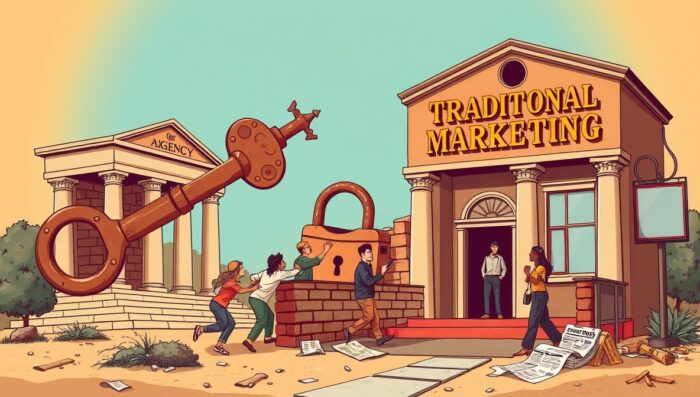
Traditional Marketing Agencies: Strong Foundations, Structural Limits
Traditional agencies bring experience, process, and human insight to the table. They understand branding, storytelling, and stakeholder management. In Singapore’s relationship-driven business culture, that still counts for something. Strategic workshops, creative ideation, and campaign planning benefit from human intuition and lived experience.
However, these strengths come with structural friction. Traditional agencies are manpower-heavy. More people means more meetings, more approvals, and longer timelines. When market conditions shift quickly, this lag becomes a liability. Decisions are often made using historical data, not real-time signals.
Costs also scale quickly. Retainers, production fees, and layered service structures make traditional agencies difficult to justify for performance-driven objectives. When every dollar must show return, businesses begin to question whether the old model still fits modern realities.
This is where AI Marketing starts to expose the cracks—not because agencies lack talent, but because their operating model was built for a slower era.
AI-Powered Marketing: Built for Speed, Designed for Scale
AI Marketing operates on a fundamentally different logic. Instead of relying on human bandwidth, it leverages automation, machine learning, and real-time analytics to execute continuously. Campaigns are launched faster, optimised constantly, and refined based on live data—not post-mortem reports.
With AI Marketing, content variations are tested simultaneously, budgets are adjusted automatically, and audiences are refined based on behaviour—not assumptions. This approach aligns perfectly with Singapore’s digital-first environment, where consumers expect relevance instantly and tolerance for irrelevance is low.
Another advantage is scalability. AI Marketing doesn’t fatigue, doesn’t slow down, and doesn’t require proportional increases in cost as complexity grows. Whether managing one campaign or one hundred, the system adapts without friction.
That said, AI is only as effective as the strategy behind it. Without clear goals, governance, and human oversight, automation can amplify the wrong signals. When used correctly, however, AI Marketing becomes a force multiplier—not a replacement for thinking, but an accelerator for execution.
Cost, Speed, and Measurable ROI: Where Reality Gets Uncomfortable
When businesses compare traditional agencies to AI Marketing, emotions fade and numbers take over. Traditional agency costs are largely fixed, regardless of performance. AI-driven models are typically leaner, more modular, and more accountable.
Speed is another decisive factor. AI Marketing reacts in real time. Creative underperforms? It’s replaced instantly. Audience fatigue detected? Targeting adjusts automatically. There’s no waiting for monthly reports to explain what already went wrong.
ROI transparency is also sharper. Dashboards show performance as it happens, not after budgets are spent. This level of visibility changes decision-making. Marketing stops being a sunk cost and starts behaving like an optimisable system.
For Singapore businesses operating in competitive, margin-sensitive industries, AI Marketing doesn’t just look attractive—it looks inevitable.
Creativity and Strategy: Redefining the Debate
The biggest misconception about AI Marketing is that it kills creativity. In reality, it changes how creativity is validated. Instead of relying on opinion, ideas are tested against real-world performance. Creativity becomes measurable, iterative, and adaptive.
Humans still define the brand voice, values, and strategic direction. AI Marketing handles execution at scale. This division of labour is not a weakness—it’s an advantage. Strategy remains human. Optimisation becomes machine-driven.
In a multicultural market like Singapore, cultural nuance still matters. AI Marketing doesn’t replace that nuance; it learns from how audiences respond to it. Over time, the system refines messaging based on what actually resonates, not what sounds good in a boardroom.
What Singapore Businesses Must Actually Decide
The real decision isn’t whether AI Marketing is better than traditional agencies. It’s whether your current model matches your business goals. If speed, scalability, and performance matter, AI-led approaches offer clear advantages. If brand positioning and long-term narrative are the priority, human-led strategy still plays a role.
Many Singapore companies are now adopting hybrid models—using AI Marketing for acquisition and optimisation, while reserving human input for direction and governance. This isn’t a compromise. It’s maturity.
The key is intent. Businesses that adopt AI without clarity fail fast. Businesses that integrate AI Marketing with purpose build durable advantages.
Conclusion: The Real Winner Is the Willingness to Adapt
There is no single winner in the AI versus traditional agency debate. The real winner is adaptability. Singapore’s market doesn’t reward nostalgia or blind faith in technology—it rewards outcomes.
AI Marketing is not a trend. It’s a response to how consumers behave today. Traditional agencies are not obsolete—but they must evolve. Businesses that understand when to use automation, when to apply human judgment, and how to integrate both will outpace those stuck choosing sides.
In the end, marketing isn’t about who’s right. It’s about who’s relevant.