
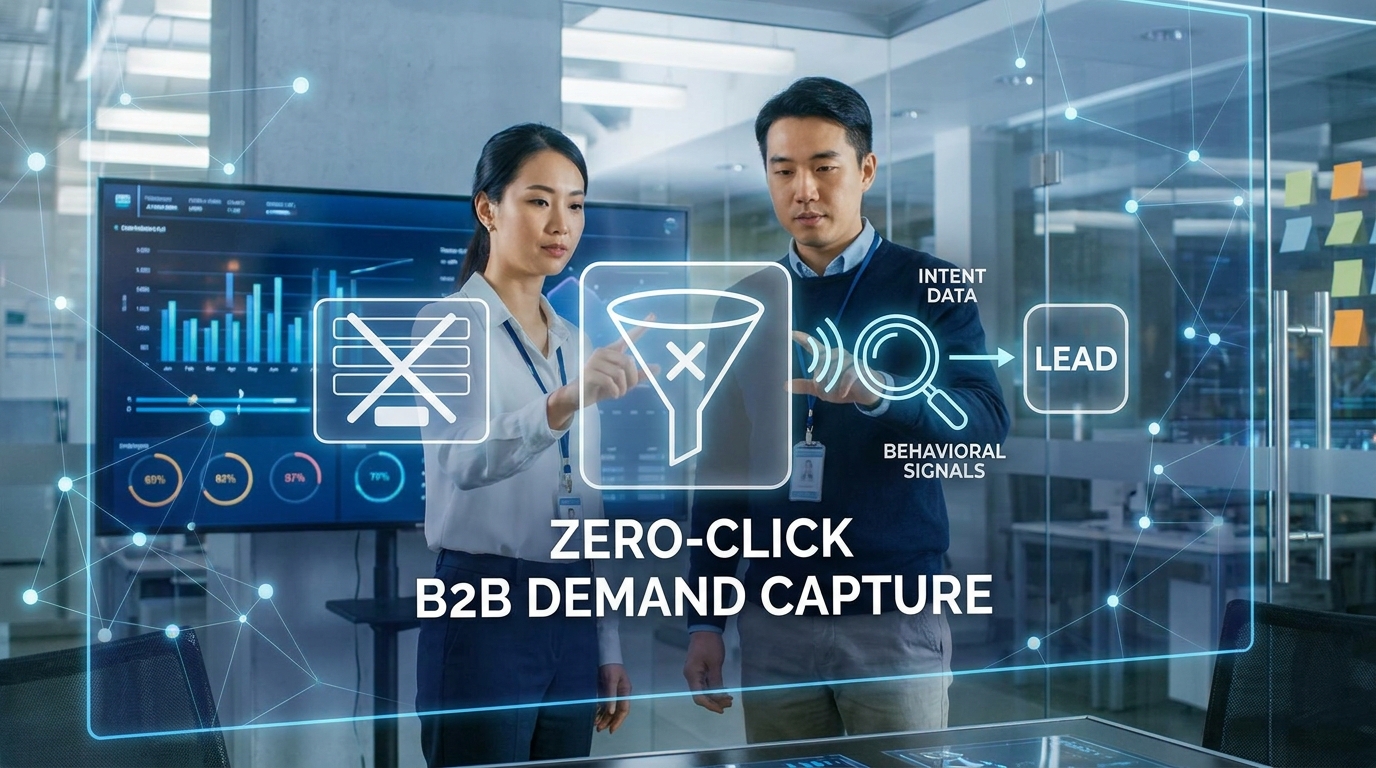
For years, B2B lead generation has revolved around a familiar exchange: attract a prospect, send them to a landing page, offer something valuable, collect their details, and pass the lead to sales. The form became the moment marketing could finally say, “We have a lead.”
But the buyer journey has become less visible.
Today, a potential customer may discover your company through an AI-generated answer, read an industry article mentioning your expertise, watch a LinkedIn video, compare solutions inside an AI chatbot, or encounter your brand repeatedly through search results — all without filling out a form. Research from Forrester in 2026 found that 94% of business buyers surveyed use AI in their buying process, while generative AI or conversational search has become an increasingly important source of information during research.
That creates a problem for companies still measuring demand primarily through form submissions.
A prospect can spend weeks researching a business problem before they ever identify themselves. They may already understand your positioning, know your competitors, and have developed an opinion about your capabilities before your CRM records their first interaction.
This is where modern B2B Lead Generation for Singapore needs to evolve.
The objective is no longer simply to force every interested buyer through a form as quickly as possible. It is to become visible and useful throughout the buyer’s research journey.
Zero-click demand generation does not mean abandoning forms. It means recognizing that the form is often the middle or later stage of demand capture, not the beginning.
The companies that understand this shift will stop asking only, “How many leads did we generate?”
They will start asking a harder question:
“How much buyer demand are we influencing before the buyer ever tells us who they are?”
That is where the real opportunity begins.
Zero-Click Does Not Mean Zero Demand — It Means Invisible Demand
The term “zero-click” can sound like a problem. If nobody clicks, how can marketing generate pipeline?
The answer is that a click is only one visible event inside a much larger buying process.
Imagine a Singapore-based operations director researching how to improve B2B customer acquisition. They ask an AI assistant for recommendations. They read three articles. They watch a LinkedIn video. They search for two agencies. They return to the AI assistant to compare approaches.
Your company appears repeatedly during that research.
But the buyer never clicks your website.
Three weeks later, they search your brand directly, visit your service page, and finally submit an enquiry.
Traditional attribution might credit the final branded search or direct visit. The earlier influence disappears.
This is why B2B Lead Generation for Singapore increasingly needs to account for pre-conversion demand.
Zero-click activity can include AI answers, search snippets, LinkedIn content, third-party publications, industry discussions, videos, comparison content, and other experiences where the prospect consumes information without immediately visiting your website.
The critical point is not whether every zero-click interaction becomes a lead.
It is whether your company becomes part of the buyer’s mental shortlist.
That distinction matters because B2B purchasing is rarely impulsive. Buyers often research vendors long before they contact them. AI search is accelerating this behavior by allowing buyers to ask questions, compare options, and synthesize information without opening multiple websites. G2’s 2026 research, for example, reports that 71% of surveyed B2B software buyers rely on AI chatbots for software research.
The old funnel assumes visibility leads to clicks, clicks lead to forms, and forms lead to sales.
The newer reality is messier.
Visibility can lead to memory. Memory can lead to branded search. Branded search can lead to evaluation. Evaluation can lead to a conversation.
The demand existed before the form.
The form simply made it visible.
AI Search Has Moved the First Conversation Outside Your Website
The B2B website used to be one of the first places buyers went to understand a company.
Increasingly, it is becoming one of several places buyers encounter information about that company.
AI search changes the sequence.
Instead of searching ten websites individually, a buyer can ask an AI system a much more specific question:
“What should a 200-person B2B company in Singapore consider when choosing a lead-generation partner?”
The buyer receives a synthesized response.
They may ask a follow-up question.
Then another.
They may compare approaches, industries, pricing models, capabilities, or vendors — without visiting a single website during the initial research.
For companies investing in B2B Lead Generation for Singapore, this means content must now be designed not only for human readers and traditional search engines, but also for the information environments where buyers increasingly conduct research.
That does not mean stuffing articles with keywords or writing robotic content for machines.
It means becoming genuinely useful.
Companies need content that answers real commercial questions with clarity. They need detailed explanations, original insights, practical frameworks, comparisons, industry perspectives, data, examples, and clear definitions.
The goal is simple:
Give buyers enough useful information that your company becomes part of the answer before it becomes part of the sales conversation.
This is particularly important because AI-mediated discovery can compress the traditional research journey. Instead of browsing dozens of pages, buyers can ask AI systems to summarize an entire category and identify relevant options.
That makes authority increasingly important.
If your company publishes shallow content that simply repeats information already available everywhere, there is little reason for buyers — or information systems — to treat it as distinctive.
But if your content demonstrates expertise, addresses specific business problems, provides useful evidence, and develops a consistent point of view, it gives the market something worth remembering.
AI search is not eliminating the need for websites.
It is changing what happens before the website visit.
Your website may still close the gap.
But your content increasingly has to open the door.
Stop Asking for the Email Address Before You Earn the Attention
One of the biggest mistakes in traditional lead generation is asking for too much, too early.
A visitor reads half a paragraph and gets hit with a “Book a Demo” button.
They download one checklist and suddenly receive a sequence of five emails.
They watch one video and are pushed toward a consultation.
The problem is not the CTA.
The problem is timing.
A buyer who is still trying to understand their problem is not necessarily ready to speak to sales. A buyer comparing solutions may not want to exchange contact information simply to access basic information. And a senior decision-maker may deliberately avoid forms until they have narrowed their options.
Modern B2B Lead Generation for Singapore therefore needs a more patient approach to demand capture.
Instead of forcing every visitor toward a conversion, companies can create multiple levels of engagement.
Someone can read an article.
Someone else can watch a video.
Another prospect can return to a service page three times.
An account may repeatedly consume content related to a specific business problem.
A decision-maker may engage with several LinkedIn posts without ever commenting.
These activities are not equivalent to a sales-qualified lead.
But they are not meaningless either.
They can become signals.
The job of marketing is to distinguish casual attention from meaningful buying intent.
This is where behavioral data, CRM systems, marketing automation, account-based marketing, and AI-assisted lead scoring can become useful. Instead of treating every visitor as a lead, businesses can look for patterns that indicate increasing interest.
The philosophy changes from:
“Give us your details before we give you value.”
to:
“Here is enough value to earn your attention. When your need becomes serious, we will make the next step easy.”
That approach does not eliminate conversion.
It makes conversion more aligned with buyer readiness.
And in B2B, timing can matter as much as targeting.
Build a Content Engine That Works Even When Nobody Clicks
If your entire content strategy depends on getting people to click immediately, you are measuring the wrong part of the journey.
Content should work even when the first interaction produces no measurable conversion.
That means building a connected ecosystem rather than publishing isolated articles.
Start with the problems your ideal buyers actually face.
Then build content around those problems.
Create educational articles for early-stage research. Publish deeper guides for buyers evaluating solutions. Develop comparison content for prospects narrowing their options. Use LinkedIn posts and short-form videos to introduce ideas. Publish thought leadership that gives decision-makers a reason to remember your brand.
For companies investing in B2B Lead Generation for Singapore, this creates multiple entry points into the same buying journey.
One prospect may discover you through Google.
Another may encounter your company through LinkedIn.
Another may see your perspective inside an AI-generated answer.
Another may hear about you from a colleague after reading one of your articles.
Different entry points.
Same demand engine.
The mistake is assuming that every piece of content needs to produce a form fill.
Some content exists to generate awareness.
Some establishes authority.
Some answers objections.
Some supports evaluation.
Some converts.
The strength comes from connecting all of them.
This is especially important in an AI-driven search environment. Buyers increasingly ask systems to synthesize information rather than simply locate websites. Research from Forrester and G2 points to AI becoming deeply embedded in B2B research behavior.
Your content therefore needs to be discoverable, understandable, credible, and useful outside the boundaries of your website.
Think of every article, video, report, and LinkedIn post as another opportunity to enter the buyer’s research environment.
The buyer may not click today.
That does not mean the content failed.
If it helps your company become recognizable, credible, and relevant when the buying problem becomes urgent, it has already done part of its job.
The Real Prize Is Turning Invisible Interest Into Actionable Buying Signals
The hardest part of zero-click demand generation is measurement.
Marketing teams are comfortable counting leads.
They are less comfortable measuring interest that never announces itself.
That is where companies need to move beyond basic conversion tracking.
A prospect who downloads a whitepaper is easy to identify.
A prospect who reads six articles over two months, repeatedly visits your service pages, engages with your LinkedIn content, and later searches for your brand is harder to connect.
But those signals can tell a much richer story.
For B2B Lead Generation for Singapore, companies can begin building a broader demand-intelligence framework around account activity, content engagement, search behavior, CRM history, campaign interactions, and sales feedback.
The goal is not to spy on anonymous individuals or turn every website visit into a sales opportunity.
The goal is to understand patterns.
Which industries are becoming more engaged?
Which accounts are returning?
Which topics generate deeper interaction?
Which service pages attract high-intent visitors?
Which campaigns produce meaningful conversations rather than cheap clicks?
Which companies repeatedly appear across multiple marketing touchpoints?
AI can help analyze these signals at scale, but technology alone does not solve the problem.
The organization needs a shared definition of intent.
Sales and marketing should agree on what meaningful engagement looks like and what happens when stronger signals appear.
A low-intent visitor might simply receive more educational content.
A repeatedly engaged account might enter an account-based nurture sequence.
A high-intent prospect could receive a relevant consultation offer.
This creates a more intelligent bridge between anonymous demand and identifiable pipeline.
The objective is not to predict every buyer perfectly.
It is to stop treating every prospect the same.
The strongest demand-generation systems do not merely collect leads. They recognize momentum.
And momentum often appears before the form.
Conclsion
The traditional lead-generation form is not disappearing.
But its role is changing.
For years, marketing teams treated the form as the moment demand became real. If a prospect completed it, they became a lead. If they did not, they were often treated as irrelevant.
That model is becoming increasingly incomplete.
Modern B2B Lead Generation for Singapore needs to recognize that demand can exist long before identification.
The buyer may have seen your content.
They may have encountered your brand through AI search.
They may have read your opinions on LinkedIn.
They may have compared your services with competitors.
They may have discussed your company internally.
They may have returned to your website several times.
Then, when the business problem becomes urgent, they finally submit the form.
From the outside, it looks like one conversion.
From the buyer’s perspective, it may have been the final step in a much longer journey.
That changes how marketing should think about performance.
Forms, conversion rates, cost per lead, and pipeline remain important. But they should sit alongside broader indicators of demand: branded search, returning accounts, content engagement, qualified website activity, AI visibility, sales conversations, and eventual revenue.
The companies that adapt will not abandon measurable lead generation.
They will expand the definition of what happens before the lead becomes measurable.
That is the real promise of zero-click B2B demand generation.
It allows companies to compete for attention before the prospect enters the CRM.
It allows content to influence decisions before sales gets involved.
It allows brands to become familiar before they become contacted.
And it forces marketers to confront an uncomfortable truth:
Your competitors may not be winning the buyer when the form is submitted. They may have already won attention weeks earlier.
The future of B2B Lead Generation for Singapore is therefore not simply about generating more forms.
It is about becoming impossible to overlook during the research that happens before the form.
Because by the time the buyer raises their hand, the decision may already be partly made.