
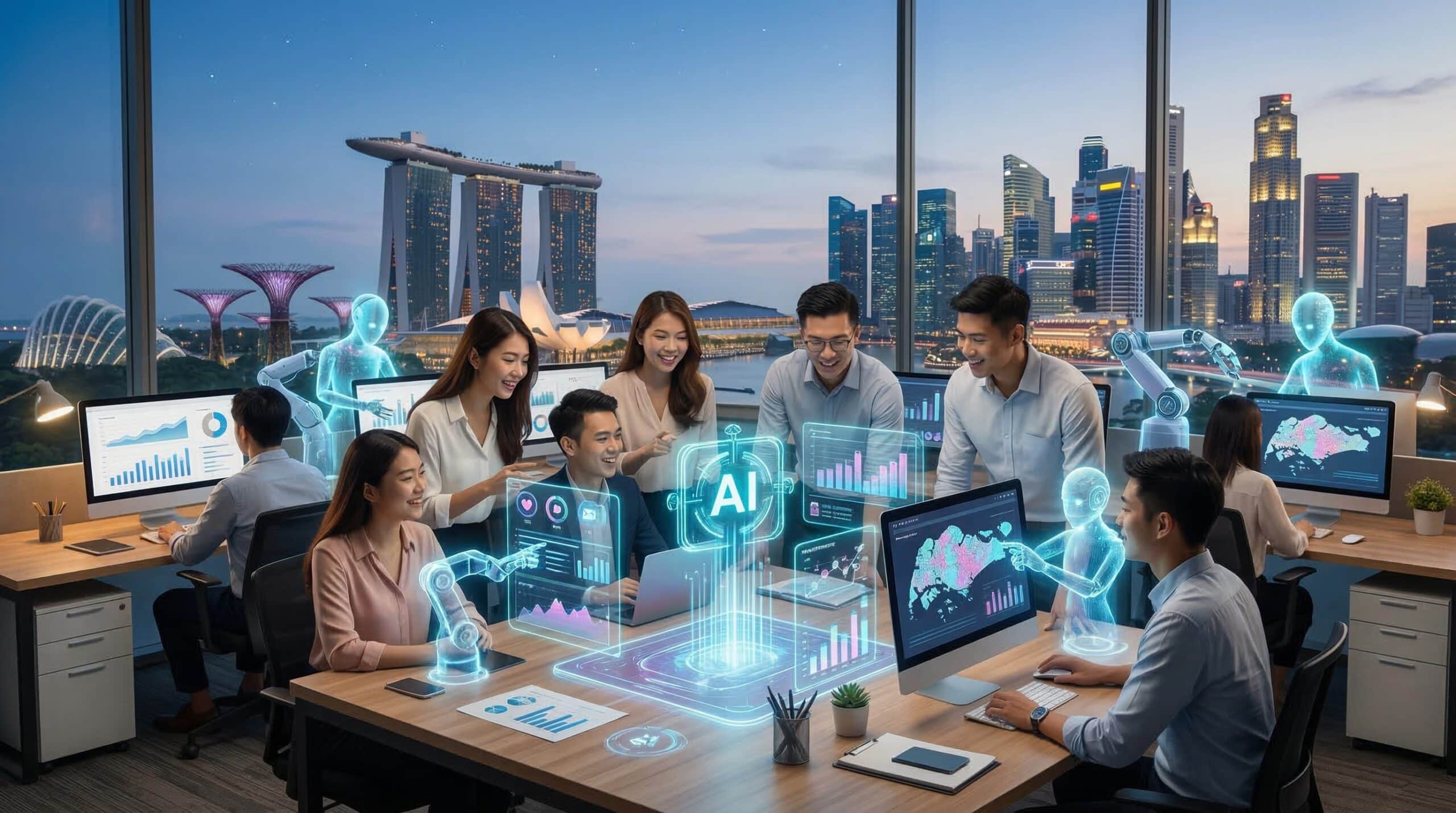
Introduction: Singapore’s Marketing Talent Crunch Is Reaching a Breaking Point
Singapore has built its reputation as one of Asia’s most advanced business hubs. Global companies base their regional headquarters here, startups scale rapidly, and digital adoption continues to accelerate across industries. Yet behind the growth lies a serious and often overlooked challenge: a widening shortage of skilled marketing professionals.
Companies across Singapore are struggling to find marketers who can manage modern digital ecosystems. Today’s marketing roles demand expertise in data analytics, automation, performance advertising, and customer experience strategy—all at once. The traditional marketing generalist is quickly becoming obsolete.
As demand grows, organizations are looking for ways to do more with fewer people. This is where AI Marketing is beginning to transform the conversation.
Rather than relying entirely on expanding marketing teams, businesses are exploring how AI-powered systems can automate repetitive work, generate insights from massive datasets, and streamline campaign execution. When deployed strategically, AI Marketing allows companies to scale marketing performance without proportionally increasing headcount.
The shift is already visible across Singapore’s business landscape. Marketing departments are integrating automation platforms, predictive analytics tools, and AI-driven content systems into their operations. This enables smaller teams to run complex multi-channel campaigns that previously required far larger departments.
But the core question remains: can technology truly solve a human talent shortage?
Advocates believe AI Marketing will fundamentally reshape how marketing teams operate, allowing organizations to operate more efficiently even with limited talent pools.
Skeptics, however, argue that while AI can improve efficiency, it cannot replace the strategic thinking, creativity, and brand understanding that experienced marketers bring.
The truth likely lies somewhere between these perspectives. AI may not eliminate the need for marketing talent—but it may dramatically change how much talent is required and what skills matter most.
Understanding this shift is essential for companies hoping to stay competitive in Singapore’s increasingly complex digital economy.

The Silent Talent Shortage Reshaping Singapore’s Marketing Industry
The shortage of marketing talent in Singapore is not simply a hiring issue—it is a structural transformation driven by the rapid evolution of digital business.
Over the past decade, marketing responsibilities have expanded dramatically. Marketers are no longer focused solely on creative campaigns or brand messaging. They are expected to manage performance data, interpret analytics, oversee marketing automation, and deliver measurable return on investment.
This shift has dramatically increased the complexity of the role.
Companies now seek professionals who can integrate strategy, technology, and data into a unified marketing approach. These hybrid skill sets are rare, and as a result, the demand for experienced digital marketers continues to outpace supply.
The talent gap becomes even more pronounced when companies attempt to scale quickly. Startups, for example, often require marketing professionals capable of managing entire growth engines—from acquisition to retention—within small teams.
This is precisely where AI Marketing begins to emerge as a practical solution.
Instead of hiring large teams to handle operational marketing tasks, businesses are turning to AI-powered systems that can assist with content generation, campaign optimization, and customer segmentation. By embedding AI Marketing into their workflows, companies can reduce the operational burden placed on individual marketers.
This approach does not eliminate the need for expertise, but it amplifies the productivity of smaller teams.
For Singaporean companies competing in a highly digital economy, this capability is becoming increasingly valuable. Businesses that effectively implement AI Marketing strategies often find they can launch campaigns faster, test ideas more efficiently, and adapt to market feedback more rapidly.
In other words, AI is not merely filling a gap—it is reshaping the structure of marketing teams themselves.

The Rise of Intelligent Marketing Systems
Artificial intelligence is no longer an emerging technology in marketing—it is quickly becoming foundational infrastructure.
Across industries, companies are adopting AI systems that can analyze customer behavior, predict purchasing patterns, and automate large portions of campaign management. These capabilities dramatically reduce the time required for marketers to gather insights and make strategic decisions.
Through AI Marketing, organizations can process massive amounts of data in real time, uncovering patterns that would otherwise remain hidden. These insights help marketers identify high-value audiences, optimize campaign performance, and refine messaging strategies with unprecedented precision.
Content production has also been transformed. AI systems can assist marketers in drafting marketing copy, generating campaign concepts, and developing personalized messaging for different audience segments. When guided by experienced marketers, these tools accelerate creative workflows without sacrificing quality.
Another powerful advantage of AI Marketing is predictive analytics. Instead of relying solely on historical performance data, AI systems can forecast potential outcomes and recommend strategic adjustments before campaigns launch.
This allows companies to allocate resources more efficiently and reduce the risks associated with large marketing investments.
For Singaporean companies operating in competitive regional markets, the ability to move quickly and make informed decisions is critical. AI-powered systems provide that agility.
As a result, AI Marketing is evolving from a technological experiment into a core component of modern marketing strategy.
Organizations that adopt these tools effectively gain a significant operational advantage—particularly when talent shortages limit the size of marketing teams.

How AI Can Bridge the Marketing Talent Gap
The most compelling argument for AI in marketing is its ability to increase productivity without increasing headcount.
In traditional marketing teams, a significant portion of time is spent on repetitive operational tasks. These tasks include analyzing campaign data, preparing reports, segmenting audiences, managing ad performance, and coordinating campaign scheduling.
While necessary, these activities consume time that marketers could otherwise dedicate to strategy and creativity.
By implementing AI Marketing solutions, companies can automate many of these operational responsibilities. AI systems can continuously monitor campaign performance, identify optimization opportunities, and generate insights without requiring constant manual analysis.
This dramatically reduces the workload placed on marketing teams.
A smaller group of skilled marketers can oversee AI systems while focusing their attention on higher-level strategic decisions. The result is a more efficient marketing operation capable of producing greater output with fewer personnel.
For organizations struggling to recruit experienced professionals, this efficiency becomes invaluable.
Instead of delaying marketing initiatives due to staffing limitations, businesses can leverage AI Marketing to maintain momentum.
The technology acts as a force multiplier—enhancing the capabilities of existing teams while reducing dependency on large talent pools.
In Singapore’s highly competitive business environment, this approach allows companies to maintain strong marketing performance even as the talent market tightens.

The Risks of Over-Automation
Despite its benefits, AI is not a flawless solution.
One of the biggest risks companies face when adopting AI-driven marketing systems is over-automation. When organizations rely too heavily on automated tools without strategic oversight, marketing output can become generic, repetitive, and disconnected from brand identity.
Creativity remains one of the most valuable assets in marketing, and it cannot be fully replicated by algorithms.
Even with advanced AI Marketing tools, human insight remains essential for shaping brand narratives, crafting emotional connections, and understanding cultural context.
Another challenge is data governance. AI systems rely heavily on customer data to function effectively. Businesses must ensure that their marketing technologies comply with regulatory frameworks such as Singapore’s Personal Data Protection Act (PDPA).
Improper data management can expose companies to legal and reputational risks.
Furthermore, AI systems require skilled operators. Marketers must understand how to interpret AI-generated insights, refine automated processes, and ensure that campaigns align with broader business objectives.
In this sense, AI Marketing does not eliminate the need for talent—it raises the level of expertise required to manage marketing operations effectively.
Companies that succeed with AI are those that combine technological efficiency with strong human leadership.

The Future: Hybrid Marketing Teams Powered by AI
The future of marketing in Singapore will not be defined by automation alone. Instead, it will be shaped by hybrid teams that combine human creativity with AI-driven intelligence.
In these teams, AI handles data analysis, campaign optimization, and operational workflows. Human marketers focus on strategy, brand storytelling, and customer engagement.
This division of responsibilities allows organizations to operate more efficiently while maintaining the creative edge that distinguishes successful marketing campaigns.
For professionals in the industry, this shift highlights the importance of developing new skills. Marketers must learn how to collaborate with AI systems, interpret algorithmic insights, and guide automated processes toward strategic objectives.
Mastering AI Marketing will likely become a defining capability for the next generation of marketing leaders.
As Singapore continues to position itself as a regional innovation hub, businesses that successfully integrate AI into their marketing operations will gain a significant competitive advantage.
Rather than replacing human marketers, AI will empower them to operate at a higher strategic level.
Conclusion: AI Is Not the Replacement for Talent—It’s the Amplifier
The marketing talent shortage in Singapore is a real and persistent challenge. As digital channels multiply and marketing strategies grow more complex, the demand for skilled professionals will continue to rise.
Artificial intelligence offers a powerful way to address this problem.
Through AI Marketing, companies can automate routine tasks, unlock deeper insights from data, and scale marketing performance without dramatically expanding their workforce.
However, AI is not a substitute for human creativity, strategic thinking, or leadership.
The most successful organizations will be those that combine technology with talent—using AI to amplify the capabilities of their marketing teams rather than attempting to replace them.
In the end, the future of marketing in Singapore will not be defined by machines alone.
It will be shaped by marketers who know how to harness the power of AI to achieve extraordinary results.