
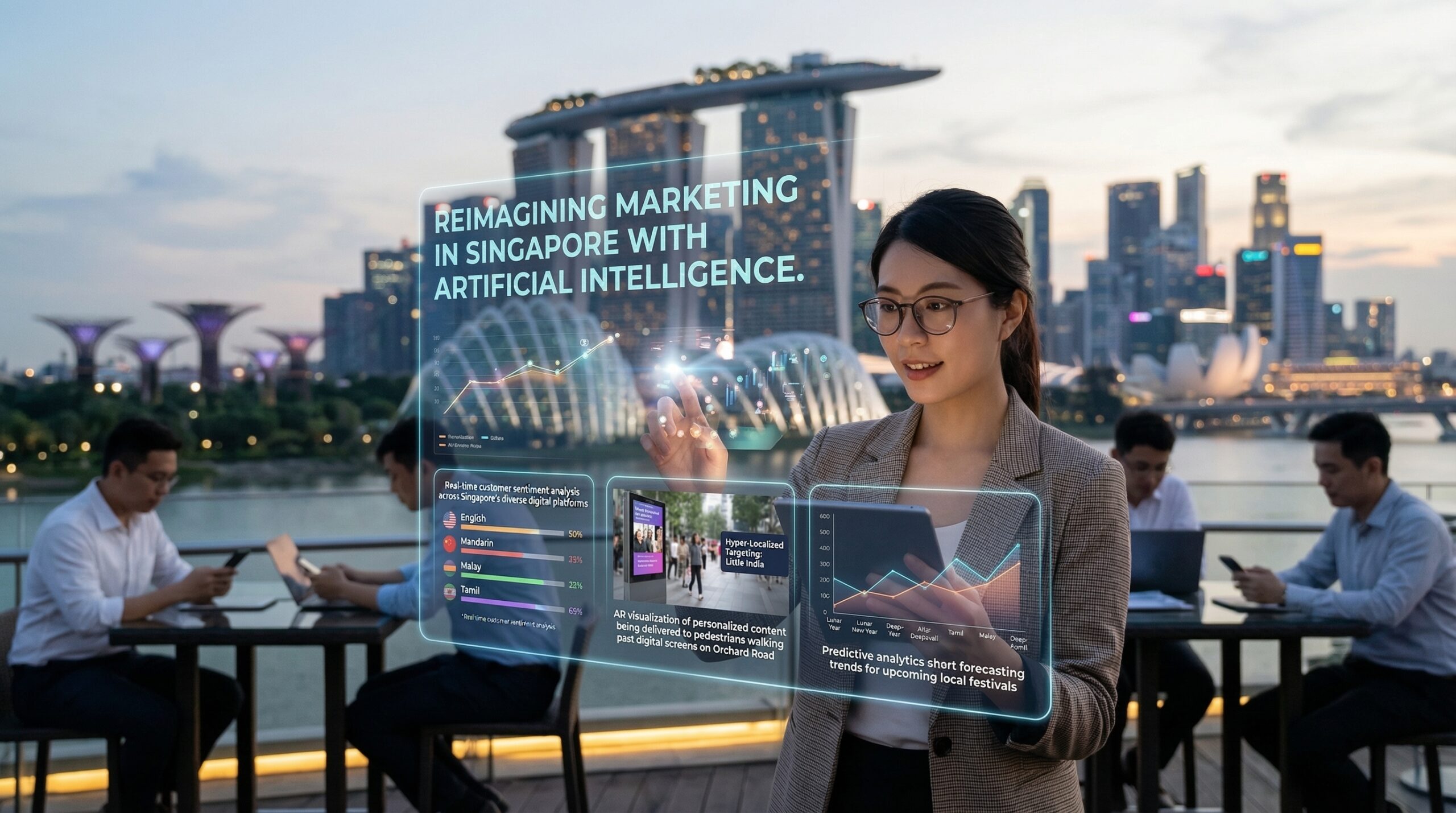
Introduction: The Silent Shift Reshaping Marketing in Singapore
Singapore’s marketing landscape has always been fast-moving, competitive, and technologically forward. Yet something deeper is unfolding beneath the surface. Artificial intelligence is quietly rewriting the rules of how brands reach audiences, make decisions, and compete in digital markets.
For years, marketing strategies relied on a mix of intuition, historical performance, and periodic campaign adjustments. That system worked when customer data was limited and digital channels were fewer. Today, however, consumers generate massive volumes of behavioral data every second—from searches and clicks to purchases and social engagement.
The brands that succeed today are those capable of reading these signals quickly and turning them into intelligent marketing actions.
This is where AI Marketing becomes central to modern strategy. Instead of relying on guesswork, businesses can analyze large datasets, identify patterns, and predict consumer behavior with far greater precision.
Singapore is uniquely positioned to lead this transformation. With its strong digital infrastructure and technology-forward economy, the country continues to invest heavily in digital innovation and business transformation.
At the same time, customer expectations have changed dramatically. Modern consumers expect fast responses, personalized experiences, and seamless interactions across digital platforms. Businesses that fail to adapt quickly risk falling behind.
The rise of AI Marketing signals more than just a technological upgrade. It marks a strategic shift. Marketing is evolving from broad messaging and reactive campaigns to data-driven precision and continuous optimization.
For companies operating in Singapore’s competitive environment, rethinking marketing through the lens of artificial intelligence is no longer optional. It is rapidly becoming essential.

The Digital Battleground: Singapore’s Rapidly Evolving Marketing Ecosystem
Singapore’s digital economy has transformed the way companies engage customers. With internet penetration among the highest in the world and smartphone adoption nearly universal, consumers interact with brands across multiple channels throughout the day.
This constant connectivity has created a dynamic marketing environment where data flows continuously and consumer attention is fragmented across platforms.
Traditional campaigns built around broad audience targeting are becoming less effective. Today’s consumers expect relevance. They expect brands to understand their interests, anticipate their needs, and deliver personalized experiences.
This shift has pushed many organizations toward AI Marketing strategies that leverage machine learning to interpret behavioral data.
AI systems can analyze thousands of variables simultaneously, identifying patterns that would be impossible for human analysts to detect manually. These insights allow companies to refine targeting strategies and deliver more relevant content to the right audience.
The rise of digital commerce and platform-based services has further accelerated this transformation. Customers today expect convenience, speed, and personalized engagement at every touchpoint.
In this environment, marketing teams must move faster than ever before. Campaigns must be adjusted in real time, messaging must evolve continuously, and customer insights must be updated constantly.
By integrating AI Marketing capabilities into their strategy, Singaporean businesses can navigate this complexity more effectively.
Artificial intelligence does not replace marketing expertise—but it dramatically enhances the ability to understand and respond to market behavior.
Intelligent Strategy: How AI Is Rewriting the Rules of Marketing
Artificial intelligence fundamentally changes how marketing strategies are developed and executed.
In traditional marketing environments, teams relied on historical reports and periodic analysis to guide decision-making. This approach often resulted in delayed insights and missed opportunities.
AI-powered systems eliminate many of these delays.
Machine learning models can analyze massive datasets in real time, identifying emerging trends and adjusting campaign parameters automatically. Instead of waiting for quarterly reports, marketing teams can make decisions based on continuously updated insights.
This is one of the driving forces behind the growth of AI Marketing in Singapore’s business ecosystem.
Organizations can now apply AI to multiple aspects of marketing strategy, including:
- Predictive customer behavior modeling
- Real-time campaign optimization
- Intelligent audience segmentation
- Automated ad bidding strategies
- Dynamic content personalization
The reason these strategies work is simple: AI enables marketers to shift from reactive analysis to predictive decision-making.
Rather than responding to consumer behavior after it occurs, AI systems can forecast likely outcomes and adjust campaigns accordingly.
This predictive capability gives businesses a powerful competitive advantage. Marketing becomes less about guessing and more about probability-based decision making.
For Singaporean companies navigating an increasingly digital marketplace, adopting AI Marketing strategies can unlock deeper customer insights and create more effective marketing programs.
The future of marketing strategy lies not only in creativity, but in intelligence.
The AI Toolkit: Technologies Driving the Next Generation of Marketing
AI-driven marketing is built on several interconnected technologies that transform raw data into actionable insights.
One of the most important components is machine learning. Machine learning algorithms analyze historical and behavioral data to detect patterns, forecast trends, and improve decision-making over time.
Many marketing platforms now integrate these capabilities directly into their systems.
Customer relationship management systems, marketing automation platforms, and analytics tools increasingly incorporate AI to help businesses interpret customer behavior and optimize marketing campaigns.
Natural language processing (NLP) is another critical technology. NLP allows machines to understand and generate human language, enabling conversational interfaces such as chatbots and automated messaging systems.
Organizations are increasingly using these tools to manage customer interactions at scale while maintaining fast response times.
Advanced analytics platforms also play a major role in modern AI Marketing strategies.
These tools provide insights into:
- Customer journey behavior
- Campaign performance trends
- Audience segmentation patterns
- Long-term customer value
Another important innovation is recommendation technology. Recommendation engines analyze user activity to suggest products, services, or content that aligns with individual interests.
This technology dramatically improves engagement by presenting customers with highly relevant suggestions.
When integrated into a broader AI Marketing strategy, these technologies enable businesses to operate with far greater intelligence and efficiency.
Marketing evolves from static campaigns into adaptive systems that continuously learn and improve.

The Responsibility of Intelligence: Data Ethics and Consumer Trust
As marketing becomes more data-driven, ethical responsibility becomes increasingly important.
Artificial intelligence relies on large datasets to function effectively. These datasets often contain information about consumer behavior, preferences, and interactions.
Businesses implementing AI Marketing strategies must ensure that data practices remain transparent and responsible.
Protecting customer privacy and maintaining clear data governance practices are essential components of responsible AI use.
Another challenge involves algorithmic bias. AI systems learn from historical datasets, and if those datasets contain imbalances, the resulting algorithms may produce skewed outcomes.
Marketing teams must therefore maintain human oversight over automated systems. AI can analyze data and provide insights, but final decisions should always consider ethical and strategic implications.
Transparency is also becoming increasingly important. Consumers want to understand how their information is being used and how brands interact with their data.
Organizations that approach AI Marketing responsibly will strengthen consumer trust and maintain long-term credibility.
Trust, once lost, is difficult to rebuild.
For this reason, ethical marketing practices must evolve alongside technological capabilities.

The Opportunity Ahead: Why Singapore Businesses Are Positioned to Lead
Despite the challenges, the opportunity ahead for AI-driven marketing is enormous.
Singapore’s economy thrives on innovation and digital adoption. Companies operating in this environment often have access to advanced infrastructure, skilled talent, and a highly connected consumer base.
These factors create ideal conditions for organizations exploring AI Marketing strategies.
One of the most powerful opportunities is hyper-personalization.
AI enables businesses to tailor marketing messages based on individual customer behavior, preferences, and engagement patterns. Instead of sending broad campaigns to large audiences, companies can deliver highly targeted experiences to each user.
Predictive analytics also allows marketers to anticipate customer actions before they occur. For example, AI models can identify signals that indicate a customer may soon make a purchase or engage with a product.
Marketing teams can then respond proactively with relevant offers or content.
AI also improves marketing efficiency by automating repetitive tasks and simplifying data analysis. This allows marketers to focus on higher-level strategy, creativity, and storytelling.
As more companies adopt AI Marketing capabilities, early adopters will accumulate valuable data insights and stronger customer intelligence.
Over time, these insights compound into a powerful competitive advantage.
Conclusion: Marketing Strategy in the Age of Intelligent Systems
Marketing strategy in Singapore is entering a new era.
For decades, successful campaigns depended largely on creative messaging and strong brand positioning. While those elements remain essential, they are no longer sufficient in a data-driven digital economy.
Artificial intelligence has fundamentally changed how marketers understand customers and execute campaigns.
Through AI Marketing, businesses can analyze vast amounts of customer data, identify patterns, and make smarter marketing decisions in real time.
Campaigns become more personalized, customer journeys become more intelligent, and marketing performance becomes more measurable.
Yet the future of marketing will not belong solely to algorithms.
The most successful organizations will be those that combine human creativity with machine intelligence. AI can analyze data and optimize campaigns, but human insight remains essential for strategy, storytelling, and brand building.
Singapore’s digital ecosystem places it in a strong position to lead this transformation.
As businesses continue to rethink their marketing strategies through the lens of AI, those willing to adapt early will shape the future of marketing innovation.
And in this new era, mastering AI Marketing will define the next generation of competitive advantage.