
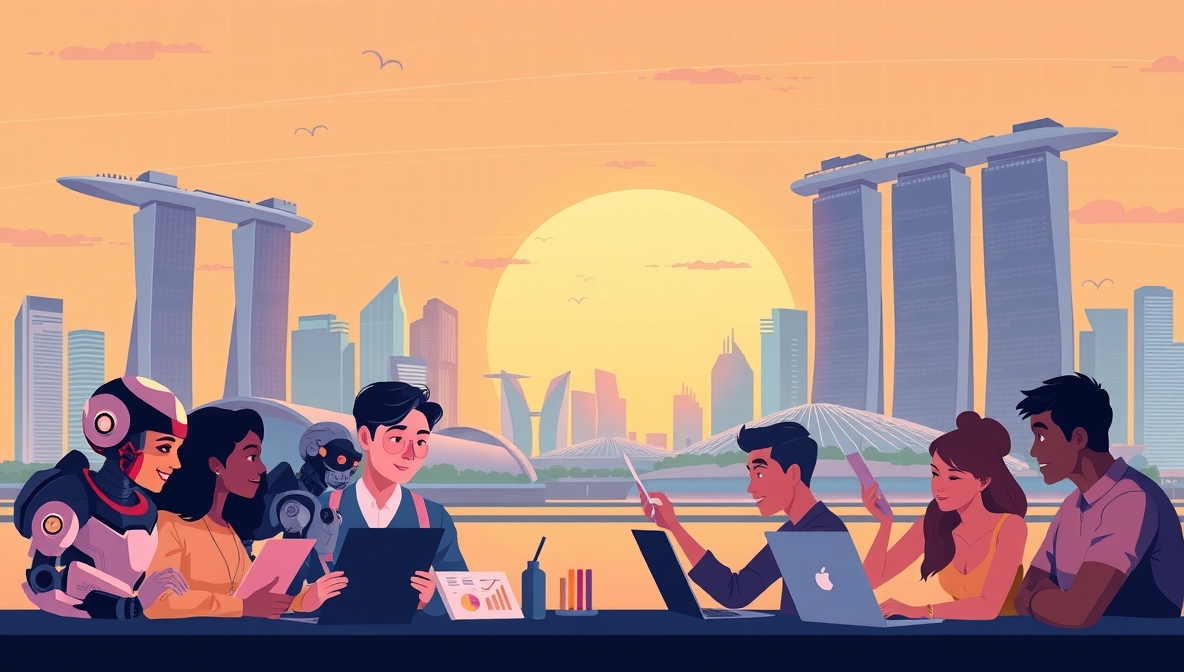
Singapore didn’t wake up one morning and decide to experiment with artificial intelligence. The shift toward AI Marketing was the result of mounting pressure—fragmented audiences, rising acquisition costs, and an unforgiving demand for measurable ROI. Traditional marketing models, built on assumptions and delayed reporting, simply stopped working.
As a digitally mature economy, Singapore offered fertile ground for AI-driven transformation. Businesses here are deeply data-aware, regulators are structured, and consumers expect personalization as a baseline. In this environment, AI Marketing didn’t emerge as a novelty; it became a necessity.
Marketing teams now operate in real time. Campaigns are launched, optimized, and refined continuously using predictive insights instead of post-campaign autopsies. Behavioral data, search intent, and engagement signals feed intelligent systems that guide decision-making with ruthless efficiency.
What makes this inflection point significant is permanence. This isn’t a trend cycle. The agencies thriving today are those that embedded AI Marketing into their core operating philosophy early—strategy first, execution second, optimization always.
Singapore’s marketing industry didn’t just evolve. It hardened.

Engineered for Leadership: Why Singapore Became Asia’s AI Marketing Powerhouse
Singapore’s rise as a regional leader in AI Marketing is no accident. The country was built to scale precision. From infrastructure to governance, everything favors efficiency, accountability, and performance—all traits that AI thrives on.
Clear regulatory frameworks around data usage allow marketers to innovate without crossing legal gray zones. High cloud adoption and enterprise-grade connectivity remove technical bottlenecks that slow experimentation elsewhere. Most importantly, decision-makers here understand that speed without accuracy is dangerous.
Agencies benefit from a market that rewards competence over charisma. Clients expect dashboards, not promises. They demand evidence, not anecdotes. This pressure has forced agencies to adopt AI Marketing not as a sales pitch, but as operational infrastructure.
Singapore’s position as a gateway to Southeast Asia adds another layer. Campaigns designed here often serve multiple markets, languages, and cultural contexts. AI enables that complexity to be managed intelligently—adjusting messaging, timing, and channels without duplicating effort.
In many ways, Singapore became the stress test for AI-driven marketing in Asia. The agencies that perform here are built to perform anywhere.
Inside the Shift: How AI Is Rewriting the Agency Playbook
Marketing agencies in Singapore no longer run on instinct. They run on systems. The creative brief still exists—but it’s now informed by predictive modeling, behavioral clustering, and performance forecasting powered by AI Marketing.
Audience research that once took weeks now happens continuously. AI analyzes millions of data points to identify intent, friction, and opportunity before a campaign even launches. Media buying has evolved from static planning to dynamic optimization, adjusting bids and placements in real time.
Agency teams have changed accordingly. Data strategists, automation specialists, and performance analysts now shape decisions that creative teams execute against. This isn’t a loss of creativity—it’s a sharpening of it.
The most disciplined agencies use AI Marketing to remove ego from the equation. Ideas aren’t chosen because they’re exciting; they’re chosen because the data suggests they’ll work.
In this new model, speed matters—but accuracy matters more. Agencies that can’t adapt are quietly losing relevance.

The Intelligence Stack: AI Tools Powering Modern Marketing Execution
The real power of AI Marketing lies in integration. Successful agencies don’t rely on a single tool—they build interconnected ecosystems that translate raw data into action.
Customer data platforms unify signals across channels. Machine learning models predict customer lifetime value and churn risk. Natural language processing refines messaging tone and relevance. Automation engines deploy content at the optimal moment, not just the scheduled one.
Search optimization, paid media, email, and social campaigns now operate as one intelligent loop. Performance data feeds back into strategy continuously, eliminating lag between insight and execution.
What separates leaders from followers is discipline. Tools are useless without governance, validation, and human oversight. Agencies that master this balance turn AI Marketing into a force multiplier, not a black box.
Technology doesn’t replace judgment—it exposes it.

The Business Impact: Why Brands Are All-In on AI Marketing
Brands don’t invest in AI for novelty. They invest because AI Marketing delivers clarity in an otherwise chaotic environment. Campaigns become more relevant, budgets more efficient, and outcomes more predictable.
Personalization at scale is the most visible benefit. Customers receive messaging aligned with their behavior, intent, and timing—without ballooning operational costs. Conversion rates improve not through louder messaging, but smarter delivery.
Attribution also matures. AI connects activity to revenue with greater precision, reducing internal friction over performance reporting. Decisions shift from opinion-driven debates to data-backed adjustments.
For leadership teams, AI Marketing provides something rare: confidence. Confidence that spend is optimized, that signals are being interpreted correctly, and that growth isn’t dependent on guesswork.

The Reality Check: Ethics, Control, and Responsible AI Use
AI introduces power—and responsibility. Singapore’s strict data protection environment demands transparency, consent, and accountability. Agencies using AI Marketing must design systems that respect privacy while still delivering insight.
Automation without oversight creates risk. Algorithms can amplify bias, misread context, or optimize for short-term gains at long-term cost. The smartest agencies keep humans in the loop—reviewing outputs, validating assumptions, and applying judgment where machines fall short.
Trust is the new currency. Brands expect agencies to use AI responsibly, explain decisions clearly, and correct errors quickly. Those who treat AI as an unchecked shortcut won’t last.
The Next Chapter: Why AI Marketing Will Define Singapore’s Future
The future of marketing in Singapore is not louder campaigns or bigger budgets—it’s sharper intelligence. AI Marketing will continue to separate disciplined operators from improvisers.
Agencies will evolve into strategic partners, advising not just on execution but on timing, prioritization, and opportunity. Those who master AI while preserving human insight will define the next decade.
Singapore’s edge has always been clarity under pressure. In marketing, AI simply makes that edge impossible to ignore.